

Transforming Building Energy Governance: An Inclusive Approach Saves 8.2 Million kWh of Energy and Cuts Carbon Emissions
Jakarta, May 2026 — Behind the intensive operations of public services, hospitals, and universities, government facility managers face mounting operational pressures. As office activities continue to grow, electricity costs and building-related carbon emissions are rising in tandem. At the same time, complying with government energy management regulations often presents a complex administrative challenge. Without a structured system in place, energy conservation efforts frequently stall at the documentation stage, with limited translation into tangible actions on the ground.
.JPEG)
Untangling Operational Challenges on the Ground
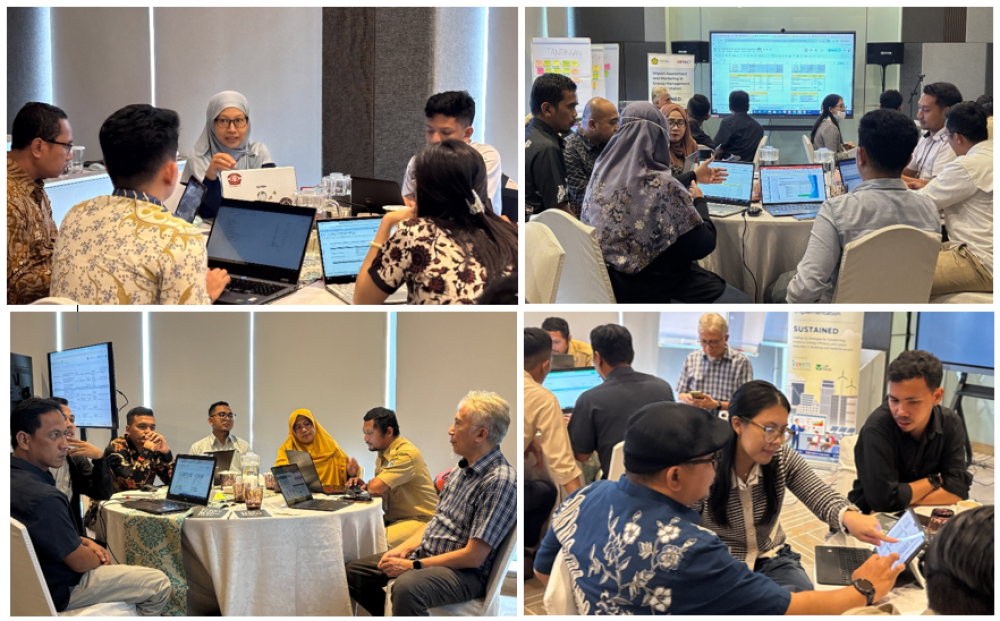
The realities on the ground became increasingly clear when representatives from 16 government institutions across DKI Jakarta, out of 21 invited organizations, came together to share and assess their experiences firsthand. The discussion highlighted that the primary challenge to energy efficiency often lies not in the absence of technology, but in the need to strengthen fundamental aspects of technical governance. These include synchronizing energy consumption data, establishing accurate baselines and targets, developing structured work plans, and accelerating the implementation of follow-up actions.
The discussion also underscored the importance of inclusion in technical facility management, a field historically dominated by men. While 81 percent of those leading energy governance evaluations within participating facilities were men, women now accounted for 19 percent of these leadership roles. Their growing participation has brought fresh perspectives that encourage more collaborative problem-solving and greater attention to detail in managing and recording operational building data.
From Administrative Compliance to Tactical Intervention
Building on these findings, IREEM, in partnership with the Directorate of Energy Conservation under the Directorate General of New, Renewable Energy and Energy Conservation (EBTKE) of the Ministry of Energy and Mineral Resources (ESDM), and supported by UK PACT Phase 2, shifted away from conventional approaches. Traditional one-way theoretical presentations were replaced with practical, operational-scale mentoring.
Building managers were no longer guided merely to prepare administrative documents. Instead, they received direct assistance in addressing systemic challenges, ranging from calibrating energy consumption data and completing Online Energy Management Reporting (POME) requirements to developing energy-saving action plans aligned with Ministry of Energy and Mineral Resources Regulation (Permen ESDM) No. 3 of 2025.
Preliminary assessment results revealed varying levels of progress among participating institutions. Several organizations achieved compliance levels exceeding 80 percent, while others fell within the 60–80 percent range, and some remained below 60 percent. A best-practice sharing session featuring pilot institutions including the Ministry of Public Works, the North Jakarta Sub-agency for Manpower, Transmigration and Energy, and Tebet Community Health Center (Puskesmas) demonstrated that technical barriers can be overcome through systematic internal commitment and sustained implementation efforts.
Systemic Impact at the Portfolio Scale
This human-centred approach to governance transformation is already delivering measurable results. A total of 11 institutions successfully completed their 2025 Online Energy Management Reporting (POME), moving from administrative uncertainty to validated compliance.
At a broader scale, this growing governance maturity has strengthened institutional confidence to implement energy efficiency investments. To date, 35 institutions have reported realizing energy efficiency investments worth more than IDR 66.6 billion. These strategic investments have been allocated to core infrastructure improvements, including HVAC system upgrades, lighting retrofits, and the development of advanced energy monitoring systems.
These efforts have proven effective in reducing the government's operational cost burden. Based on a comparison of 2024 and 2025 energy performance data from 16 of the 23 reporting institutions, total energy consumption was reduced by 8,146,601 kWh. This achievement has made a significant contribution to decarbonization efforts, resulting in an estimated reduction of approximately 7,088 tonnes of CO₂ emissions.
“The materials and insights provided through this programme have equipped us with valuable knowledge to drive organizational improvements moving forward. We are highly optimistic about the implementation of energy management, as it aligns closely with the Sustainable Development Goals, particularly those related to sustainable and clean energy,” said Riezka Novia Bewinda, Head of the General Affairs Division of the DKI Jakarta Provincial Government.
.JPEG "Ibu Riezka Novia Bewinda")
The success of these institutions reinforces a fundamental principle: energy management is not simply about turning off lights. It is about building a data-driven culture, fostering inclusive leadership, and committing to long-term investment. Together, these elements form the foundation for resilient, efficient, and low-carbon government facility operations.